2026 – present
Anthropic Fellows Program
Research Fellow
Research coming soon.
I'm currently a research fellow working on AI safety. I enjoy figuring things out, then making something with what I learn.
In prior work, an agent playing Montezuma’s Revenge gets stuck at the top rung of a ladder. The rung is an instrumental state: useful for reaching a reward. Conflation mistakes that future usefulness for reward now.
We extended the theory to let conflation vary across states. Our three-state model shows how error at a useful step can trap an agent there, despite the cost of staying.
Aligning Superintelligence, Stanford.

With Leo Li. Mentored by Alex Infanger.
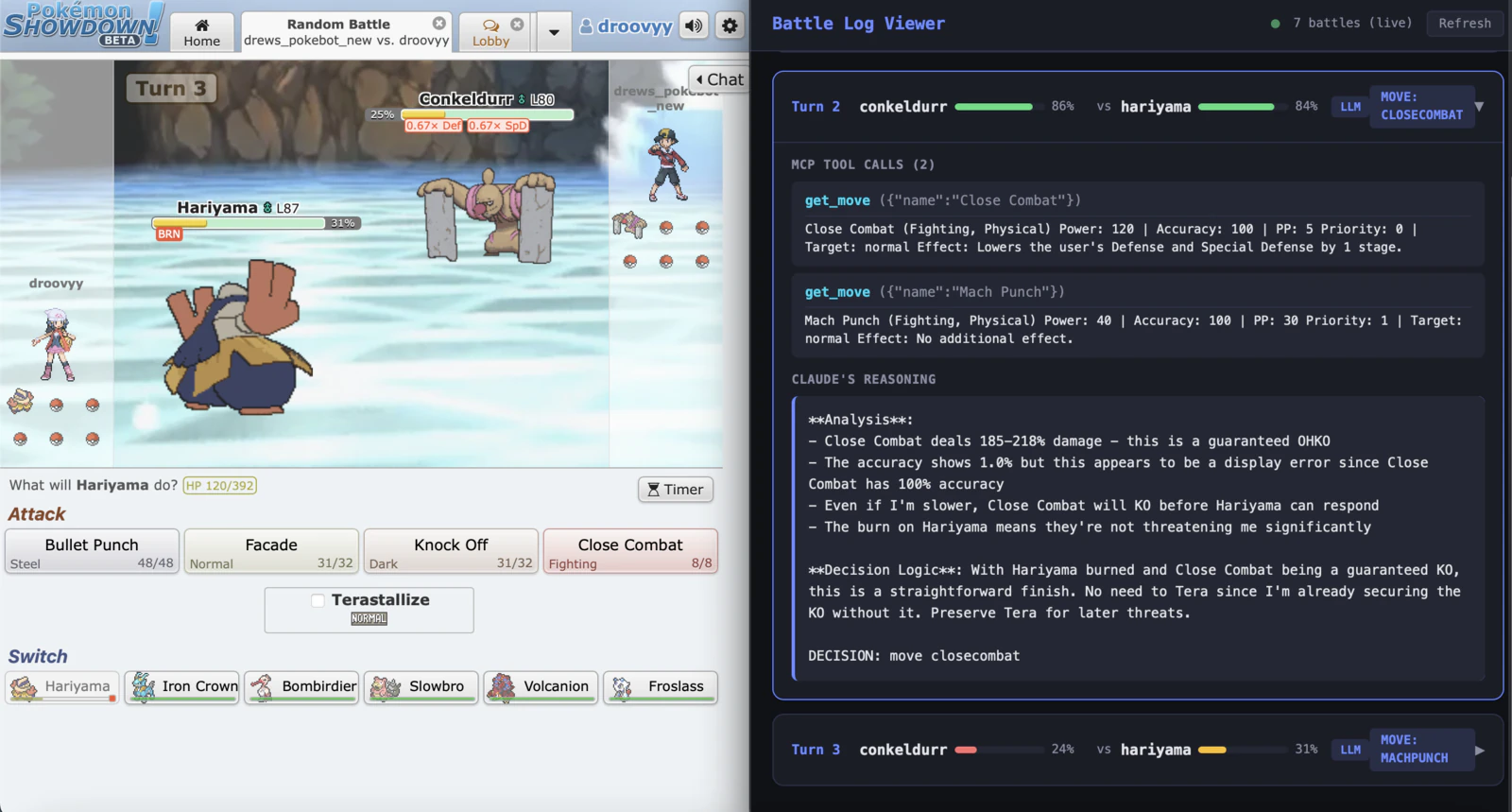
We gave gpt-oss-120b a hard math problem, then used its attempts to generate easier practice problems. We kept problems where 60–80% of its answers agreed and used the majority answer as a training label. This is test-time training: the model learns while working on the target problem, using GRPO reinforcement learning.
On one FrontierMath Tier 3 problem, the solve rate rose from 0.67% to 32.4% at step 90 after we cleaned and regenerated the subproblem curriculum.

With Darrow Hartman and Leo Li. Mentors: Chenglei Si and Luke Bailey. Faculty sponsor: Tatsunori Hashimoto. Supported by a $10K grant from Thinking Machines Lab.
We trained an agent to balance guesses that rule out words with guesses that could solve the puzzle, using PPO and an information-gain reward. It solved all 500 evaluation games in an average of 3.51 guesses. A comparison strategy that always chooses the most informative guess (greedy entropy) also solved all 500, averaging 3.61 guesses.

With Ethan Hersch and Manav Kant.
We built a robot that drives to a shooting position, fires three pucks, and returns to reload. Three ultrasonic sensors guide navigation; an encoder controls the firing mechanism.
An Arduino state machine runs the sequence with a 100 Hz control loop. Stopping briefly before measurements improved the consistency of the ultrasonic readings.
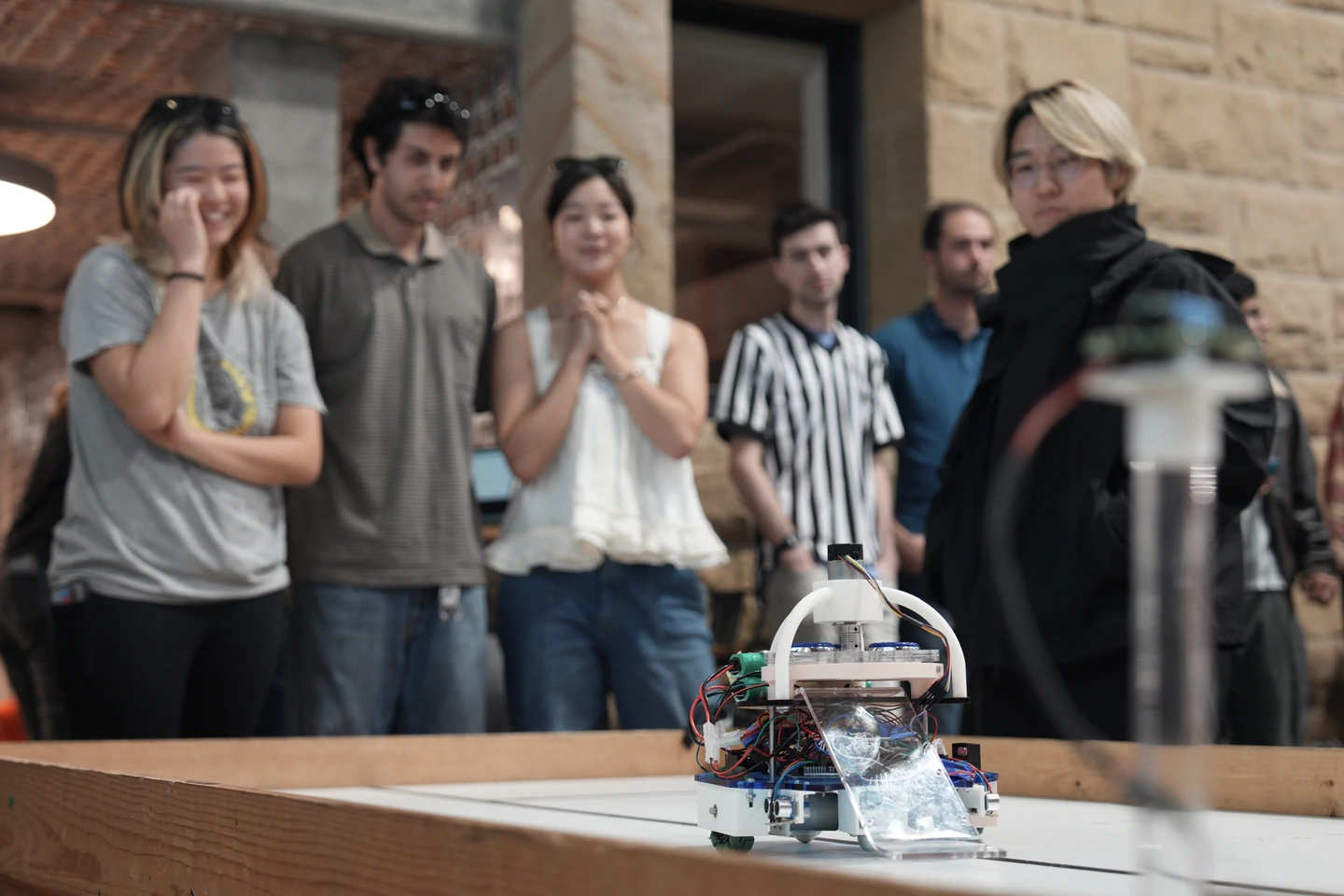
With Senching Hsia, Jeremy Merritt, and Libby Ye.
We built a 1.6m soil bed with 15 mycelium cultures and six fluorescent sculptures, modeled in Blender and 3D-printed in flexible TPU plastic. Electrodes and a Pico ADC-24 sent voltage readings from the mycelium to a MacBook Pro. A Python script used those readings to trigger recorded clips and adjust the volume of ambient sound loops.
An Arduino Mega rotated the sculptures on staggered timers, reversing the motors to keep the suspension lines from tangling.
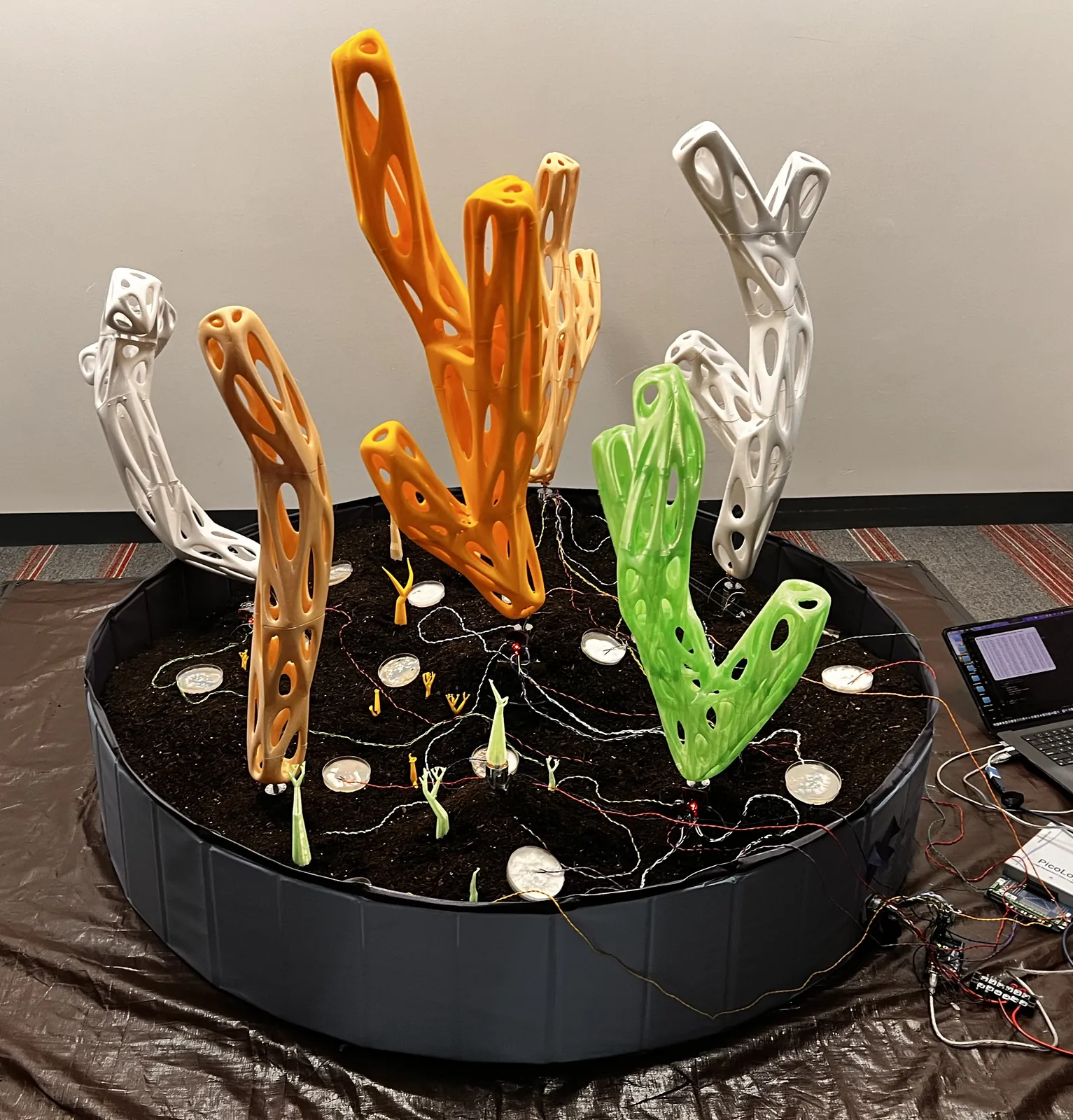
With Libby Ye.
2026 – present
Research Fellow
Research coming soon.
2026 –
Software Engineer
Built oversight and evaluation tools for self-improving oncology agents.
2025 –
Software Engineering Intern
Built sensitive-data classification and internal PCI compliance tools for Global Payments. Worked on CapCut user-data migration for the US TikTok sale.
2024–2025 –
Technical Cofounder
Used reinforcement learning to correct long-range weather forecasts for agriculture, commodities, and power markets, as part of Stanford GSB Startup Garage.
2024 –
Undergraduate Research Assistant
Built memory and reminders for GPTCoach, an AI agent for fitness and behavior change. Acknowledged in Bloom, which received a CHI 2026 Best Paper Award.
2022–2024 –
Core Member & Financial Officer
Organized XR events and managed club funds. Placed second at the annual hackathon.
2022–2024 –
Software Engineering & ML Intern
Worked on models to detect depression and anxiety from voice and EEG signals.
2023 –
VR Software Engineer
Worked on Virtual Becomes Reality for Quest 2 using Unity and C#.
2023 –
Founding Software Engineer
Designed interfaces for a computer vision and fashion startup.
Outside work: chess, golf, boxing, snowboarding, scuba diving, and fermentation.